



Childhood Obesity Screening and Awareness Program Departments of Paediatric Physiotherapy & Cardiopulmonary Physiotherapy
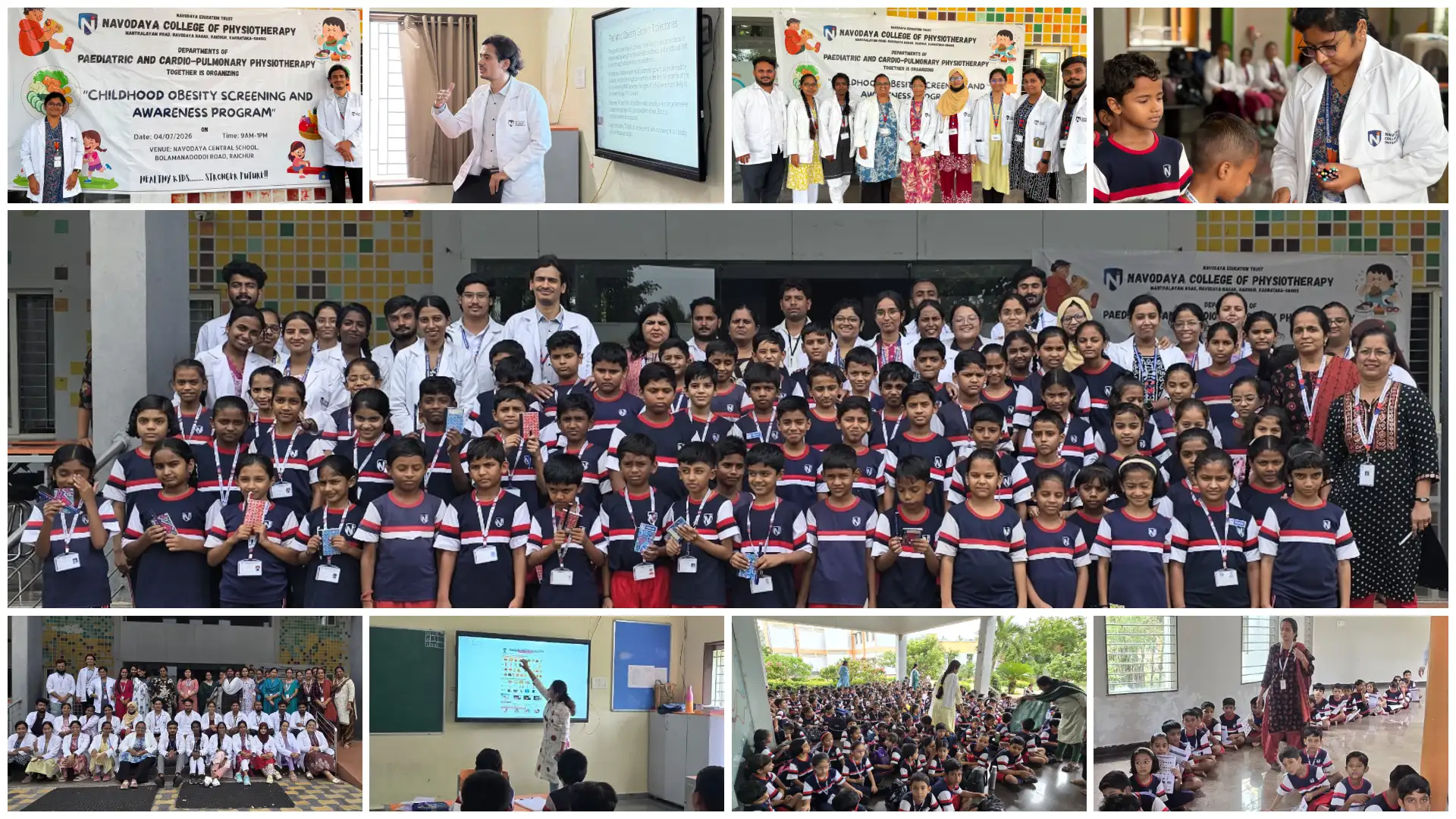
The Departments of Paediatric Physiotherapy and Cardiopulmonary Physiotherapy, Navodaya College of Physiotherapy, successfully organized a “Childhood Obesity Screening and Awareness Program” at Navodaya Central School, Raichuru on 4th July 2026. The event was coordinated by Dr. Padmavati S. Patil, Associate Professor, In-charge, Department of Paediatric Physiotherapy, in collaboration with Dr. Yateendra P, Professor and HOD of Cardio-Pulmonary Physiotherapy.
The program aimed to screen children from 1st to 5th Standard to identify childhood obesity and create awareness regarding its prevention among school teachers. Approximately 400 school children participated in the screening program.
The event commenced with an orientation session for the class teachers, recognizing them as the children’s second parents and emphasizing their crucial role in promoting healthy lifestyles. The organizing faculty, Dr. Yateendra P, delivered an informative session covering the causes of childhood obesity, associated risk factors, possible complications, early warning signs, and preventive measures that can be implemented within the school environment.
The Headmaster, Principal, and teaching faculty of Navodaya Central School extended their wholehearted cooperation, contributing significantly to the smooth execution of the program.
Following the awareness session, the teachers were introduced to a structured questionnaire designed to gather information regarding the children’s dietary habits, physical activity and play patterns, screen time, sleep duration and quality, and general health status. The questionnaires were completed with the assistance of the respective class teachers and collected for further assessment.
The screening was then conducted systematically, class-wise and section-wise. Postgraduate students from the Departments of Paediatric Physiotherapy and Cardiopulmonary Physiotherapy, along with internship students, carried out comprehensive assessments of each child. The evaluation included demographic data collection, measurement of height and weight, Body Mass Index (BMI) calculation, observational findings, postural assessment, and anthropometric circumference measurements. Around 400 children were successfully screened during the program.
As a token of appreciation for their enthusiastic participation, pencils, pens, and mini notebooks were distributed to all the children. The event concluded with group photographs involving the school management, faculty members, organizing team, and class-wise groups of students, creating lasting memories of the occasion.
Beyond its academic and clinical significance, the program became a memorable and heartwarming experience for everyone involved. The innocence, curiosity, and cheerful participation of the children transformed the screening into a joyful and engaging learning experience. The active interaction of students from higher classes, who eagerly enquired about the activities, further enriched the event. It served as a reminder that curiosity, enthusiasm, and innocence remain invaluable qualities throughout life.
The success of the program was made possible through the dedicated efforts of the organizing faculties, the postgraduate students of the Departments of Paediatric Physiotherapy and Cardiopulmonary Physiotherapy, and the internship students, all of whom worked tirelessly throughout the event. Their commitment, together with the unwavering support of the Principal, Headmaster, and teaching faculty of the school, made the Childhood Obesity Screening and Awareness Program a meaningful, educational, and highly successful initiative.